

Praying For People Who Do Abortions
Understanding Who We’re Praying For
I want to ask you to pray with me–to cry out–for the men and women who are doing abortions as part of their job in the city of Hong Kong and elsewhere in China.
I once had a dream, where I was in an abortion clinic, and I had to help the doctor with abortions. During that dream, I think I had the same kinds of experiences as anybody who does abortions. It was a mix of positive and negative thoughts, feelings, and justifications regarding my involvement with abortion.
But by the end of the dream, what I experienced doing this job was not pleasant!
And in real life, I believe that this job is not only unpleasant–it is also unnecessary!
The training, skills, and gifts of medical professionals ought to be used to save lives, and to create health solutions that are life-affirming, not life-destroying.
There are hundreds of people in Hong Kong who directly participate in the abortion process in some way. And there are literally millions of people throughout China who help with abortions as part of their job. This includes doctors, nurses, administrative staff, and the many people who advertise for abortion. It also includes the medical waste personnel, and the developers and distributors of abortion equipment and medication. And it also includes the millions of people working or volunteering with the CFPA–the Mainland China affiliate of the International Planned Parenthood Federation.
Sadly, the idea of “conscientious objection” that many in the West take for granted is not an option for medical professionals in China. Currently, there are very few pro-life OBGYNs.
Prayer Points For People Who Do Abortions In Hong Kong And Mainland China
1. Pray for the social workers at the FPAHK branches, and the staff of the CPFA, who are counselling pregnant women. Pray that they will have a change of heart. Pray that they will find ways to counsel each woman towards choosing life, rather than trying to persuade her to abort.
2. Medical staff are often trained to encourage abortion for any and every possible reason. When there might be a very small chance of a health complication during pregnancy, the first response is to encourage abortion. This is medically unreasonable and morally inhumane, and also results in the abortion of many perfectly healthy babies. And this pro-abortion mentality also keeps Chinese doctors from addressing underlying medical problems. But nurses, doctors, and radiologists have tremendous influence over parents’ decisions. So we really must pray for them!
3. Pray for many medical professionals to have a conversion of heart, to be confronted with the terrible reality of abortion, and to find a way out.


5 Notes About Praying At Hong Kong’s Biggest Abortion Clinic
This is not a list of rules or “how-to” advice for praying at an abortion clinic. So far in Hong Kong, it has not been feasible to do sidewalk counselling ministry or to hand out pro-life materials. So, what I’m doing there is really, simply, prayer. I sit or stand outside the building, and read the Bible, and pray for an end to abortion.
Below, I wrote down some of my experiences while praying outside the abortion centre in Wanchai each week during the past month. Some of the stories are meaningful. And some, honestly, are kind of weird.
By the way, as far as I know, I have still never had any conversations with clinic workers or patients. And there are too many people going in and out of this 30-storey building (which is mostly filled with government offices) to know who is there for an abortion. But this FPAHK abortion centre in Wanchai is responsible for at least 3,000 abortions every year. It’s a kind of “ground zero” for abortion in Hong Kong, which is why it’s been at the centre of pro-life prayer efforts in Hong Kong. Overall, my times there are sobering, but also very motivating for pro-life work–for working to build a culture of life.
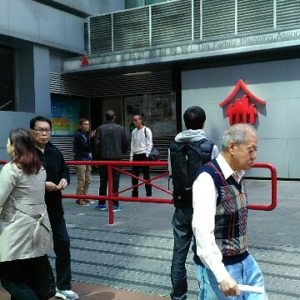 I took this photo of one person praying in front of the Family Planning Association main office in Wanchai, during the 40 Days for Life campaign in 2017. Some random guys are smoking near the entrance. Everybody else is walking by on the sidewalk.
MARCH 27: Shortly before I arrived at the abortion centre to pray, I read news that a friend from university was on his deathbed. David Szostak was married, had 4 kids, and exhausted every medical possibility for his health condition. In the end, he needed to be taken off life support.
I didn’t know David very well. But he was very joyful and faithful, and he spent much of his short life working in pro-life ministry. I’ve cried in front of an abortion clinic for a lot of different reasons. But this was something different.
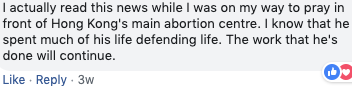
A friend had offered to pass on notes of prayer and encouragement while David Szostak was on his deathbed. I wrote this note while I was in front of the abortion centre.
APRIL 3: While praying in Wanchai, I couldn’t help but think of Ching Ming Festival (April 4), when people go to cemeteries to clean family graves and burn incense. The ashes in the air always make me sick.
Afterwards, I saw a very weak old man in a wheelchair, with old grey scabs on his head (strangely, the scabs looked like ashes). He needed help being pushed in his wheelchair, and I helped him into a government building lift in Wanchai. Two hours later, I saw him again, and he probably didn’t even recognise me, since his head was bent down so far. He needed help to go home. He was mentally ill and didn’t want to talk much. But he let me push him back to his home. His home was a large mattress and a few bags inside of a subway (an underground walkway). It’s right beside the Happy Valley Racecourse, across the road from the Hong Kong Cemeteries and Crematoria Office. Dozens of poor and mentally disabled people live right there, in that little network of subways. I know there are many NGOs and Christian groups that try to help these people, but they want to live there. It’s so sad.
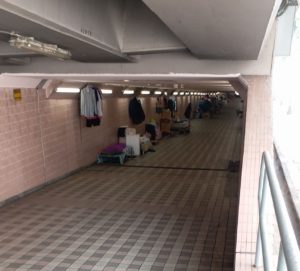 Dozens of street sleepers are living underground, right between the Happy Valley Racecourse and the Hong Kong Cemetery.
APRIL 10: There was a window-washing gondola near the top of the Southorn Centre office building. So, the street level entrance for the Family Planning Association was zoned off with yellow caution tape. And that meant that I needed to stand a bit away from the building, on the sidewalk. The yellow tape was supposed to keep pedestrians from standing near the building, because of the possibility of something falling off the gondola and hitting them. But there was a section that was not taped off, so that people could continue walking in and out of the FPAHK office. This is the main office, where people can get health exams, contraceptives, etc. It’s also where people can get the morning after pill, as well as book abortion appointments.
The gondola overhead was an obvious safety concern, so nobody was allowed near this part of the building–except for the people who were going in and out for their reproductive health appointments. It was so weird that their safety didn’t seem as important.
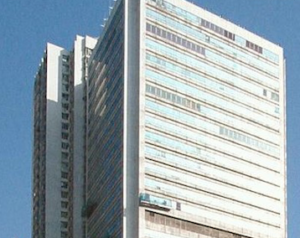 Gondolas outside of the Southorn Centre. The FPAHK main office entrance is directly below the gondola on the left.
APRIL 17: I prayed and read the Bible. Honestly, I was very distracted for most of my time there, but I finished praying, and left. Three hours later, I got a WhatsApp message, about a couple I’d met recently. They had just experienced a miscarriage. After so much joy, now there was so much pain.
And I thought of all the women who chose abortion–or who were told that they had no other choice. And I thought of all the people that would be willing to do anything–even to adopt if necessary–if it would make a difference for someone who is planning to get an abortion.
APRIL 24: Nothing really unusual happened this morning. But a bird landed right beside me, and walked around busily less than a metre away from me. I’ve been to this spot so many times, but I don’t remember that happening before.
I thought he was looking for food, because pedestrians had thrown leftovers in some bushes there. But he was actually looking for nesting material. After about 2 minutes of searching, the pigeon found a very long, strong twig, and carefully flew off. He was doing his best to build a space for his babies, because that’s what pigeons do.
 (Stock photo from depositphotos.com)
“Look at all the birds—do you think they worry about their existence? They don’t plant or reap or store up food, yet your heavenly Father provides them each with food. Aren’t you much more valuable to your Father than they?” (Matthew 6:26, The Passion Translation)
Recently, some people asked me if I would be leading the March for Life again this year. They hadn’t gotten the update that I wouldn’t be able to lead any big pro-life event this year.
Honestly, even a simple weekly prayer time is not easy. But I decided to continue going weekly, for a short period of two months. My goal in this season is to remember the basics of what pro-life ministry is about, and the lives that are at stake.

China’s Invisible Women, Conclusion: The Hope of Single Mothers
This English translation was originally published on the China Partnership Blog on March 29, 2019, and is replicated here with permission. We thank Hannah, Brent, and the China Partnership translation team for their work. Background research information in the introduction.
Conclusion: The Hope of Single Mothers
“Single mothers in China hope for the same thing, that government policies would no longer fine them and that they may easily register their children for a hukou. If, in addition to this, they also received affirmation and support from society, then that would be even better. As single mother Gezi said, ‘Just raising a child is hard enough. But single mothers do not have the means to protect themselves or to live independently, much less to fight for themselves.’
…As for support from society, there are almost no organizations that help single mothers, due to the fact that their reproductive decisions are illegal according to China’s family planning regulations. The only organization I found online that offers help to single mothers is unregistered and does not have a physical office. It is a Buddhist organization made up of volunteers from different Buddhist temples. The organization is struggling to stay in operation due to lack of funds. The help it can offer to single mothers is very limited.
Single mother Mengmeng still hopes for the best. ‘I think that however different each single mother’s story is, there is one thing we all share in common—namely, as a disadvantaged group, we all need the affirmation and support of society.’
May the day come when mothers who give birth out of wedlock are no longer punished by laws and policies; may people be more understanding of single mothers and respect their decision to give birth; and may we see more governmental organizations and NGOs offering financial and emotional support to impoverished single mothers and children.

Prayer Points (China Partnership):
- Pray that Christ would be the hope of single mothers in China. Ask God to provide the earthly benefits of hukous and social acceptance to the children of single mothers, but pray that both mothers and children will know of their eternal hope in heaven and the promise of the Holy Spirit for those in Christ.
- May God’s people be a light to society by demonstrating what is good, true, noble, and life-giving through their treatment of single mothers against what is false, self-righteous, and cruel.
- Pray that the church becomes the first in action caring for China’s single mothers. May the glory God’s name deserves in such work not go to Buddhist organizations or secular NGOs, but may it be done in Christ’s name.
READ: China’s Invisible Women, An Intro: The Unbelievable Dilemmas Single Moms Face

China’s Invisible Women, Challenge #2: Societal Discrimination Against Single Moms
This English translation was originally published on the China Partnership Blog on March 29, 2019, and is replicated here with permission. We thank Hannah, Brent, and the China Partnership translation team for their work. Background research information in the introduction.
Challenge #2: Societal Discrimination Against Single Moms
A single Buddhist mother said: ‘If I had aborted my child, I would be having a good life. But I decided to keep the child and to become a single mother. Single mothers are particularly vulnerable to societal discrimination. Many people think we are promiscuous.’ The fact that many think single mothers are ‘promiscuous’ shows the moral discrimination single mothers face in society.
There are a couple reasons why single mothers are morally condemned in Chinese society. On the one hand, they defy traditional sexual and reproductive ethics. On the other hand, their decision to give birth breaks from the traditional family structure of one husband and one wife. The partners of some single mothers are married. These single mothers will very likely be called humiliating names like ‘ernai’ (concubine) or ‘xiaosan’ (mistress) by society.[2]
Single mothers have reproductive freedom. It is unreasonable to place this moral burden on their shoulders. The partners of those being called ‘ernai’ and ‘xiaosan’ have violated marriage law, and yet society does not humiliate them with similar names. This reveals the gender inequality inherent in society’s moral condemnation. Moreover, the definition of ernai is quite ambiguous. Not all single mothers whose partners are married are ernai.
For instance, Meigui’s partner is married. But Meigui doesn’t consider herself a xiaosan or an ernai because she has more financial resources than the father of her child. Moreover, she has basically taken on the responsibility of raising the child all by herself. Even so, Meigui has suffered many years of insults by the wife of her partner. ‘We both feel miserable in this relationship, and the law doesn’t protect us. To some degree, I am a victim too. But what am I supposed to do? I’m not sure.’ Those who use the term ernai stigmatize single mothers by embracing traditional societal morals.
Moral pressure pushes many single mothers to hide their identity. For example, consider Meigui. Even though she does not see herself as a xiaosan, she still keeps her marital status a secret from her family members. ‘My hometown is somewhere else. I have lived in Guangzhou for twenty years. When I gave birth, he (her partner) went to my hometown with me and told my mother we were married. To this day, my family knows nothing about him being married to a different woman.’
Those whose partners are single also choose to hide their identity, fearing shame and a lack of understanding from society. Migrant worker Kafei, whose partner left her because his family disapproved of their relationship, chose to give birth and gave her child to her parents back home to raise for her. She continues to work in the city to support her family. Kafei said that people would ‘look down’ on her if she told them. She said she didn’t want others to know because ‘it isn’t a good thing.’ ‘Even someone who has experienced exactly the same thing won’t show me empathy.’ Therefore, she hides her identity as a single mother at work.”
[2] Translator’s note: Ernai usually refers to a young mistress of men with wealth and high social status who primarily seek material and monetary rewards from the relationship. Xiaosan is used for women who commit adultery with men of normal social status. The term connotes wrecking others’ marriages and families.

Prayer Points (China Partnership):
- Pray for repentance and mercy for the fathers who have abandoned their children. Ask the Spirit to begin a work of reconciliation in their hearts.
- Pray for women who continue in ungodly relationships to repent and find the strength in Christ to live according God’s design for life. Pray that their identities would be renewed in Christ, empowering them to live as daughters of Christ with the benefits of being his heirs.
- Pray against a culture that encourages abortion as a way to absolve responsibility. Pray that men and women will come to fear God and recognize the sanctity of life.
- Pray for the church to have a robust, public voice concerning marriage, the family, and sexual intimacy. As China’s family structures continue to deteriorate, pray that what the church has to say about God’s design of men, women, and the family is heard as good news and hope.
READ: China’s Invisible Women, Conclusion: The Hope of Single Mothers

China’s Invisible Women, Challenge #1: Registering Children With No Legal Identity
This English translation was originally published on the China Partnership Blog on March 29, 2019, and is replicated here with permission. We thank Hannah, Brent, and the China Partnership translation team for their work. Background research information in the introduction.
Challenge #1: Registering Children for Hukous
“Single mothers face an urgent but thorny problem—how to register their children for hukous.[1]
Xiaojun, unwilling to meet in person or talk on the phone, sent me a personal account of her story. She wrote, ‘My child was not granted a birth certificate and still does not have a hukou. The family planning department created a case and fined me 80,000 RMB. They fined him (Xiaojun’s partner) over 100,000 RMB. Together the fines total over 200,000 RMB. They said even if I pay off my fine, our child cannot register for a hukou until both of our fines are paid. He will never pay the fine, so there doesn’t appear to be any hope that our child will get a hukou. She is almost three and about to enter preschool. Without a hukou, education will become a huge issue for her in the future.’
…[Chinese law] is saying that the only people who can legally give birth are married couples. By giving birth out of wedlock, single women violate this article, and their births are considered ‘illegal births.’

The family planning regulations in every province punish births out of wedlock, although the amount fined and the way in which couples are fined differ… In some provinces, single mothers face a more severe punishment if they have children with married men… Some provinces, however, do not distinguish between having a child out of wedlock with a married person and having a child out of wedlock with a single person…
To many unmarried mothers, the exorbitant social compensation fee is daunting. But if they do not pay off the fine, their children will not be able to register for a hukou. And if they do not register for a hukou, they cannot obtain citizenship. Consequently, they will be ineligible to receive social benefits like public education, healthcare, and social security. It will even be difficult for them to purchase train and air tickets for traveling.
These mothers rack their brains trying to get hukous for their children. Some obtain hukous by means of relationships with people back in their hometowns in the villages. The fines are less in the villages, but registering there means these children cannot attend public schools where they are currently living. Others register their child on another family’s hukou. And still others are quietly waiting for the census, hoping that during the census their children can obtain a hukou without spending any money. Among the single mothers I contacted, less than one third have successfully registered their child…”
[1] Translator’s note: The hukou system is an individual and household registration system in mainland China. It is similar to social security in the US. The process of registering for a hukou is strictly regulated. A hukou serves as a form of identification and also grants access to social benefits, including but not limited to public education, healthcare, employment, and housing compensation.

Prayer Points (China Partnership):
- Where corruption is seen as the norm and integrity does not often amount to political gains, pray for the increase of wise, God-fearing officials who notice social injustices and labor to improve current laws for the common good.
- Ask God to protect and provide for the children of unmarried parents, every one of whose lives he treasures.
- Ask God to financially bless churches caring for single mothers so that they may provide diaconal assistance regarding the financial burdens single mothers face in China.
China’s Invisible Women, Challenge #2: Societal Discrimination Against Single Moms

China’s Invisible Women, An Intro: The Unbelievable Dilemmas Single Moms Face
This English translation was originally published on the China Partnership Blog on March 29, 2019, and is replicated here with permission. We thank Hannah, Brent, and the China Partnership translation team for their work.
Intro
Over the past month, China Partnership has been focusing on the stories and needs of women in honor of Women’s History Month.
The following excerpts were originally published in The Paper. In his article, Gao Biye, a post-doctoral scholar at the Chinese Academy of Social Sciences Institute of Sociology, explains the difficulty that China’s current social policies pose for women who choose to give birth and raise their children as single mothers. Here, we are given a glimpse into the plight of this “invisible group” of moral outcasts, despised by society and penalized by the law.
As we pray for women in the Chinese church this week, we invite you to take a moment to also pray for these single mothers and their children. Read through the following article excerpts and then pause to pray according to the provided points and according to the Spirit’s leading.
Ultimately, pray that the Chinese church would not be outdone in kindness, but rather that it would be a channel of Christ’s love for the lost and true hope for the sinner.
Excerpts from Chinese Sociologist Gao Biye
“For the most part, China does not yet have demographic data regarding single mothers. There are many reasons for this. First, this group is considered ‘illegal’ in Chinese society for violating the state’s family planning policy. Therefore, they are not officially recognized. Second, some tend to hide their identity as unmarried mothers. Moreover, these identities are subject to change. After meeting compatible partners, they may tie the knot and become married women. In order to shed light on the circumstances these mothers are dealing with, I conducted in-depth field research among them from 2014 to 2015…
Most single mothers refused my invitation. One commented, ‘Each time we talk about this, we have to walk through the pain, anger, and hurt again. We have come a long way to finally reach some peace.’ The words of this single mother demonstrate why this group chooses to remain silent. As for those who did the interview with me, many broke down in tears during our phone calls. As a result of their choice to give birth, they have suffered legal punishment, moral shame, and financial hardship. Each time they narrate their experiences, they are reminded of the heartbreak.
The single mothers I contacted live in different cities in China. I do not know their real names or what they look like. Many even refused to tell me their birthplace and current residence. But through their words, I could sense their kindness, their struggle, and their bravery. Through deep conversations with these single mothers, I discovered how government policies, financial stress, and social discrimination have made their lives extremely difficult.”

Prayer Points (China Partnership):
- Secular wisdom does not know the path of grace. It is either blind to human sinfulness or it despises the sinner. Ask God to raise up his church to care for single mothers in Christ-honoring ways, ministering to them in grace and truth.
- Praise God for stories of courage – stories of single mothers choosing the hard way of giving birth. May they come to know the saving power of Christ and learn to walk in newness of life.
- Ask God to give single mothers more courage to speak out about their stories so that the church may become more aware of their needs.
READ: China’s Invisible Women, Challenge #1: Registering Children With No Legal Identity

“Jesus, help me!” A dad’s adoption testimony
I was introduced to a man (I’ll call him “John”) who was passing through Hong Kong. After some small talk, he mentioned that his daughter had been adopted from Hong Kong over 20 years ago. So I asked him to share the story.
He flew in from America to complete all the paperwork for the adoption. His wife wasn’t able to be there to pick up their daughter. Unfortunately, John had to finish the process by himself. No small task! But finally, everything was finished, and he was ready to bring his daughter home.
But his daughter wasn’t ready. Every time he tried to hold her, she cried uncontrollably. After a few days of this, it got to the point where every time she saw him, she started crying uncontrollably.
Time was running out before his return flight to America. He didn’t know what to do. He kept trying, kept praying, and kept doing everything he knew to make her trust him.
John was getting desperate. Finally, while he was holding her and she was screaming at him, he cried out: “Jesus, help me!”
His daughter stopped crying. They bonded. And John took his daughter home to America, to meet her new mother and family.
After John finished the story, he mentioned that his daughter had grown up with a disability–she was missing an arm. And during the adoption process, he was told that she was “severely retarded”. But she wasn’t.
John said, “She just finished nursing school last month. She was the valedictorian.”

Pro-Life Theme in “Life on the Line” (Hong Kong TVB Best Drama of 2018)
This is the first TV series that I watched in Cantonese, so it holds a special place for me just because of its importance in my personal language learning journey. But I was also pleasantly shocked by some of the pro-life themes of the show.
“Life on the Line” (跳躍生命線) is a fairly lighthearted drama about the real lives and work of paramedics in Hong Kong. The plot was great, the dialogue was good, and the acting was completely “Hong Kong style”. But despite the serious situations in each episode, there isn’t as much screaming and yelling and overly dramatic acting as a lot of TV shows have!

There was a lot of heroism, and a lot of struggles to figure out messy family/relationship issues, and a lot of life-and-death ethical questions. I don’t watch a lot of TV, but this was a surprisingly good show!
The most surprising thing, though, was the show’s treatment of abortion. In the middle of the series, one of the major plot points involves a doctor who persuades one of his girlfriends to get an abortion. (Spoiler alert: There’s actually a happy ending!)
While the girlfriend is waiting in the hospital room to get an abortion, the audience is made keenly aware of the humanity of the unborn child, because of the words that the pregnant woman uses to talk about the child she’s planning to abort.
Later, the boyfriend/doctor is called a “murderer”. This is what happened: The doctor’s fiancée finds out that he has another girlfriend, and that she’s pregnant, and that she’s getting an abortion. If the fiancée can accept the other woman’s abortion, then she’s free to move ahead with her wedding plans. She loves him and has waited to marry him for 10 years, so this is a very serious moral struggle.
But finally, she tells him that in her career as a medic, all she wants to do is to save people’s lives. And even though she loved him, she “could never sleep with a murderer”.

In this scene, they’re checking out beds at a mattress store before their wedding. She realizes that she cannot sleep with a doctor who would be willing to murder his own flesh and blood.
Honestly, I was kind of shocked. From my perspective as a pro-life advocate, I’m very careful about the words I use. If you’re talking with someone about abortion, using words like “murder” can be a conversation-stopper, and maybe a relationship-ender. To stress the point, I think it’s generally a very bad idea to call people who do abortion “murderers”. It’s counter-productive, and calls to mind the generic image of “Bible-thumping Christians” who yell because they don’t know how to have a real debate. For the record, the pro-life leaders I know try to use language that will actually be persuasive. (Because obviously, this beats trying to shout louder than the people they disagree with.)
But in the context of this TV drama, the issue of abortion did not feel like a philosophical debate. And it had nothing to do with religious or political stances. It was just plainly and refreshingly true: even though this doctor was a hard-working man who saved lives, he was morally a criminal. He was unfaithful to his fiancée, and he wanted to have his mistress’s child killed. So yes, the audience should have no problem calling him a “murderer”.
Fortunately, the doctor does finally have a change of heart about the abortion. He marries the mother, and lives “happily ever after” (and presumably stops keeping any extra girlfriends).
It’s just a TV show, but it meant a lot to me personally. I plan to be here in Hong Kong for decades. And so even though I don’t have a big TV habit, I do need to be able to understand Cantonese-language media. Watching “Life on the Line” was a new experience, and I’m grateful to have gotten to this point in my Cantonese study.
I also was impressed that the characters dealt with life-and-death situations with careful moral judgment. For instance, they brought up the question of when it’s okay to risk your life to save someone else. And they dealt with questions about caring for your family versus saving the lives of strangers, etc.
They also featured a character in the medic training school who had Down Syndrome. He wasn’t a major character, but he was there, and he was part of the team. That was cool, because they gave a positive impression about a young adult with Down Syndrome, working hard to start his career. That’s not something I’m used to seeing on TV.
ARTICLE: “Finding Nemo” and searching for Down Syndrome in Hong Kong

I was also very happily surprised to see that “Life on the Line” won the award for the best TV drama series of 2018! The TVB Awards Show is broadcast during Chinese New Year, which means that a lot of Cantonese-speaking families saw it during lunch on the second day of Chinese New Year (i.e. one of several big meals for extended family during the week of CNY). I don’t think I’ve ever been interested in watching a TV awards show before. But I made an exception, because my wife’s family was watching it (we had 30 people gathered for lunch in a tiny apartment–with a big TV screen–because this is Hong Kong).

So, cheers for “Life on the Line”. It was a really good series, and I hope more TV producers will promote the value of life in Hong Kong!

Ray of Hope in Taiwan :: Pre-Chinese New Year 2019 Prayer Update
|
||||||||||||||||||||||


Burial for Miscarried Fetuses Under 24 Weeks Gestation
There have been several news stories in the past year, of parents in Hong Kong who had an early miscarriage, and even though they desperately wanted to bury their child, they were not allowed to. The Hong Kong government only allowed burials for fetuses who died after 24 weeks gestation.
During the past year, the Hong Kong Catholic diocese has made it possible for Catholic parents to have legal burials. Before that, only private informal burials were possible, and there was no way to perform them legally.
Starting next year, three cemeteries in Hong Kong will be following the example of the Catholic Church in creating “Angel Gardens”. This is not necessary or possible for many couples. But for couples who want to do this, it will be a beautiful way to remember their child.
Miscarriage is not an easy subject to discuss. Even the grammar and vocabulary is difficult, and I still don’t know the proper terms to use in English. For example, should we say, “early miscarried fetus”? Or “child that died in an early-term miscarriage”? Or “early miscarriage baby”?
Medical professionals say “abortus”, and also refer to a “miscarriage” as an “abortion”. This can be very confusing. I understand the logic of the medical terminology. And maybe it’s linguistically more convenient. But it leads to a lack of empathy (and clarity) in communicating with patients.
Anyway, it’s important that we learn how to talk about miscarriage in a way that’s respectful and humane, and also ordinary. Because miscarriage is surprisingly common.
The Christian Cemetery in Tao Fong Shan is planning to start as soon as possible, pending government permission. They will hold a press conference on December 24 about this new part of their ministry.
This post is also available in: 繁體中文

Recent Comments