

“Too many people!”
The most common complaint about Hong Kong is “overpopulation”. Hong Kong has “too many people”, and “not enough space”.
If you’ve ever been in Hong Kong, you’ve definitely experienced how tight the space feels. And compared to many other metropolises, Hong Kong does not have a lot of space. It’s smaller than Los Angeles, but has twice the population.
But what you never hear is that–unlike Los Angeles or any other metropolis in the world–nearly everyone in Hong Kong lives in less than 4% of the land area. Practically speaking, the government allows people to use only about 1/25th of the city’s space for housing.
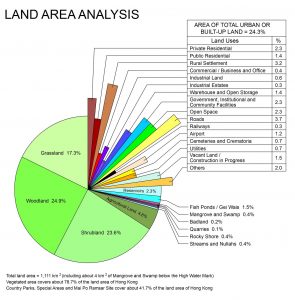
In the pie chart below, you’ll see that 2.3% of land is for “Private Residential” use, while 1.4% is for “Public Residential” use. Basically, Hong Kong people are permitted to live in only 3.7% of the city. The exception is the “Rural Settlement” areas, which comprise 3.2% of Hong Kong. But rural housing is tightly controlled, and many rural residents continue to trickle from old squatter villages into the main population centres.*
Hong Kong has the technology and the resources to develop any part of its land, or to extend its land into the water, or to build new islands. Instead, they are committed to the idea of overpopulation. This is not a healthy attitude!
Hong Kong is often seen on country ranking charts (even though it has been a Chinese city since 1997). So you’ll see on Wikipedia that Hong Kong is the 100th most populous region in the world (compared to all other countries and territories), and the 4th most densely populated (the other three are Singapore, Monaco, and Macau).
Hong Kong is a city, not a country
The problem with this ranking is that Hong Kong is a city, and acts like a city. So, it would make a lot more sense to compare it to other major cities. And if we do that, then Hong Kong no longer seems as incredibly densely populated as Wikipedia suggests. There are several dozen cities that have a higher population density.
Does that mean that Hong Kong is actually not that crowded? Is it government propaganda, or Hong Kong’s complaint culture? Or is something else going on?
Let’s look at it from another angle. To start with, we’ll include only the built up areas of cities. If any land falls inside the city limits, but isn’t actually used by people, then we won’t include it in our calculations.
If we do this, then we’ll see that Hong Kong is the only major city in the world with less than a quarter of the city built up for the use of humans. Look at that chart again. The total area of urban or built-up land is 24.4%. Do you know of any other major city that uses less than 75% of its space? Less than 50%?
Also note that this figure of 24.4% includes public parks, golf courses, remote village houses, construction areas, and a few dozen square kilometres of open space.
By the way, I’ve looked earnestly for every possible reason that Hong Kong uses so little of its land. I still haven’t found a reason that makes any sense, except one: landowners want to maximise profits.
Hong Kong is mostly empty
Anyway, if we look only at the places where people have actually built something (roughly 1/4 of the land area), the population density in those regions of the city would rise dramatically. Again, no other major city uses so little space as Hong Kong does, and most cities actually develop or utilize the great majority of their city’s space in some way. Hong Kong is a dramatic outlier, and this is another reason that Hong Kong feels so much more densely populated than comparison charts would suggest.
But let’s go one step further. Let’s include only the places where people actually live. When we do this, then Hong Kong has 68,671 people per square kilometre, or 177,809 people per square mile.**
Most major cities have a reasonable proportion of space assigned for housing. Since Hong Kong has about 2,755 square kilometres in total, how much should be used for housing? There is no other city that has confined over 7,000,000 people to live inside of 102 km² (39.3 mi²). Why does Hong Kong do this? The people running things are obviously very smart, since they have what might be the most efficient housing system in the world. But, what is the point of boxing everyone’s houses into a tiny fraction of the built-up space–and then also keeping the vast majority of the land totally empty?
Hong Kong strictly maintains the current land use policy–fully aware that this is leading to all sorts of frustration, tenancy abuse, safety problems, and a general sense hopelessness–but say there is nothing they can do about it, because of overpopulation and lack of space. This is amazing–but what is more amazing is that everyone believes them.
I know I already showed this image above, but seriously, you need to take some time to look at it. And then think about what you’re going to say next time someone tells you “There are too many people”, or, “There isn’t enough space.”
Seriously, what will you say?
Endnotes and Calculations
The information in this post was gathered from publicly available Hong Kong government documents.
*I searched extensively for the rural settlement population, but found limited data. There are very few rural settlers, perhaps in the 10,000s or low 100,000s.
**Below is the method I used to arrive at the figure of 68,671 people/km² in Hong Kong:
1. Remote villages have a very small percentage of the population. I could not find a specific number anywhere, but I guess it is under 100,000 people. For argument’s sake, we can overestimate, and say that 400,000 people live in remote villages.
2. That means there are still at least 7,000,000 people in Private and Public Residential areas. If you look at the chart above, you’ll see that Private and Public Residential areas comprise 3.7% of Hong Kong’s total area, i.e. 101.935 km² out of 2,755 km².
3. I divided 7,000,000 by 101.935 to arrive at the residential density figure of 68,671 people/km² in residential areas. I went through the same process to arrive at 177,809 people/mi².
Again, these figures are lower than the real number, because there are more than 7,000,000 people who live in the Private and Public Residential areas. Also, most people in Hong Kong live in apartment compounds that contain convenience stores, supermarkets, and restaurants. This means that literally thousands of commercial shops operate within the 3.4% of space that the Hong Kong government has allotted for residential areas.
It would take a lot more research to confirm this, but Hong Kong may have the most densely populated residential areas in the world. (It already has more tall buildings than any other city.) Amazingly, most of the city’s space remains untouchable under the city’s zoning and environmental regulations.

Recent Comments